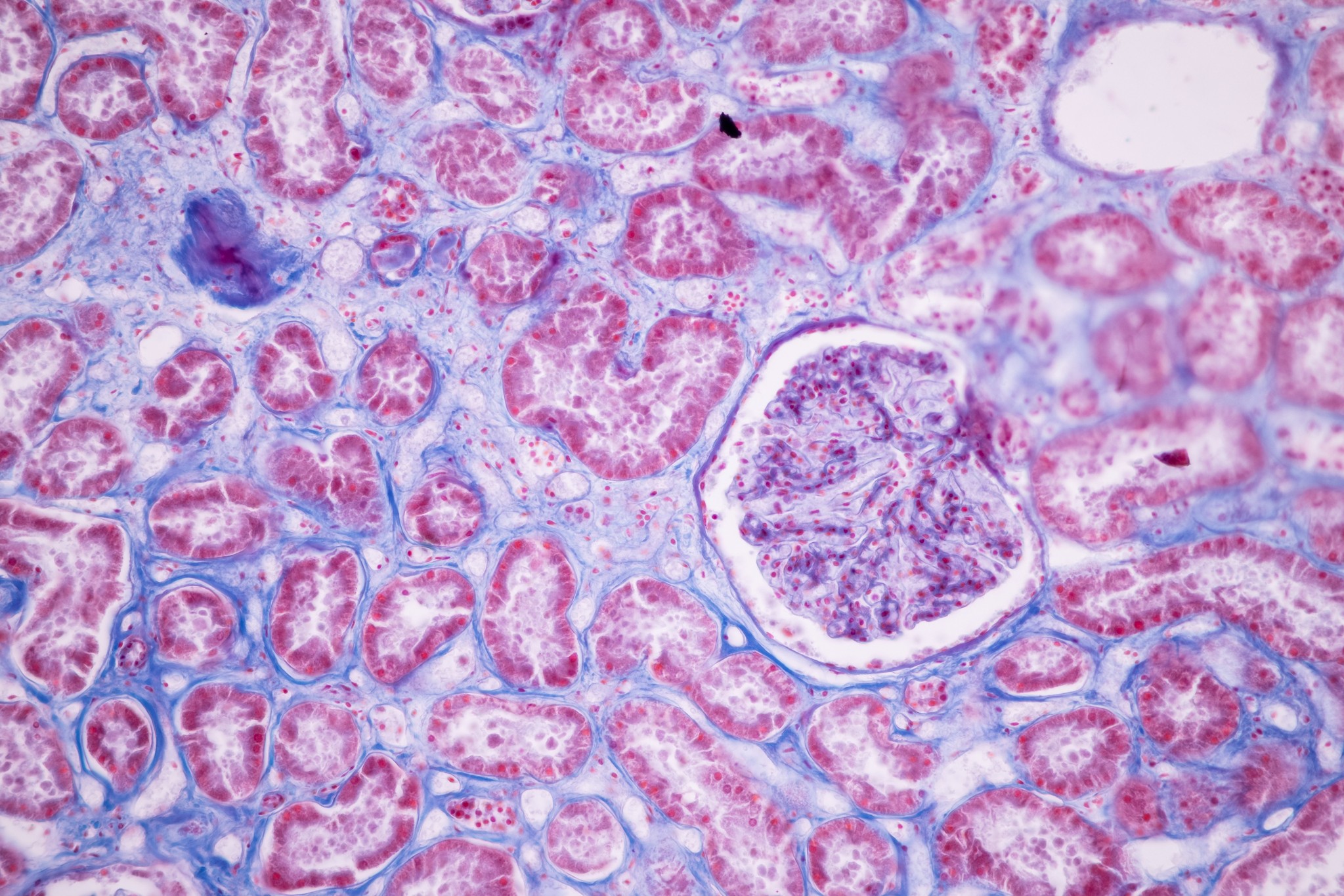

About Diffusion Models, Cancer Cell States and Iterative Generative Exploration
Single-cell cancer data provide detailed molecular snapshots but cannot reveal how individual cells differentiate between healthy and tumour states. CancerZigZag uses iterative diffusion modelling to explore such state changes computationally without requiring paired healthy-tumour measurements.
Single-cell RNA sequencing has transformed our understanding of tumour heterogeneity. However, most cancer datasets are cross-sectional: healthy-like and tumour cells are observed, but the transitions connecting these states remain unknown.
CancerZigZag addresses this limitation using a generative diffusion framework. A model learns the latent distribution of tumour-derived epithelial cells and subsequently explores this tumour-associated state space starting from individual healthy-like cells. It thereby transforms a single healthy seed state into the tumorous distribution without the need of knowing the entire healthy distribution.
The challenge of modelling cancer cell-state transitions
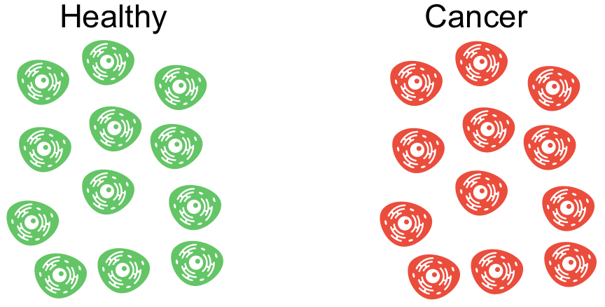
Single-cell cancer datasets contain independent snapshots rather than longitudinal measurements of the same cells. Therefore, the molecular states connecting healthy-like and tumour cells cannot be directly observed.
Traditional trajectory and pseudotime approaches organize existing cells along inferred structures. CancerZigZag instead takes a generative approach and explores additional tumour-associated states within a learned molecular landscape.
Learning a tumour-associated latent landscape
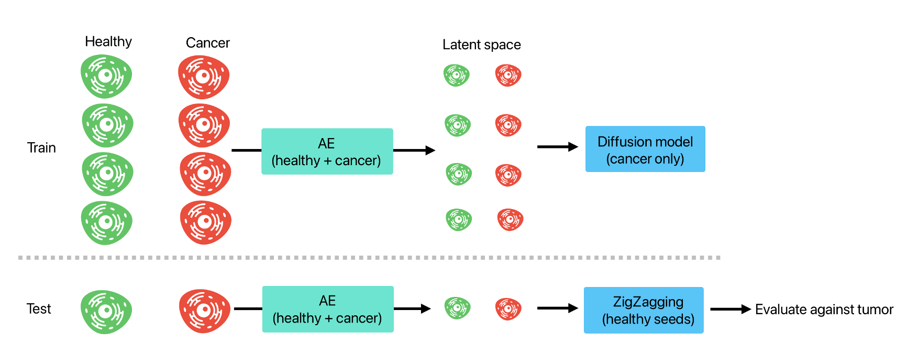
CancerZigZag first represents single-cell expression profiles in a lower-dimensional latent space using a variational autoencoder. A diffusion model is then trained exclusively on tumour-derived epithelial cells.
During training, noise is added to tumour-cell representations and the model learns how to reverse this process. Healthy-like cells are not used for diffusion-model training. They enter the framework only during generation, meaning that no paired healthy–tumour cells, longitudinal observations, or lineage information are required.
Iterative ZigZag diffusion
Generation starts from the latent representation of an individual healthy-like cell. CancerZigZag repeatedly applies partial perturbation followed by reverse diffusion using the tumour-trained model.
Each ZigZag cycle moves the current representation through the learned tumour-associated landscape. The resulting state becomes the starting point for the next cycle, enabling progressive exploration rather than a single transformation from healthy to tumour.
The number of cycles and the strength of perturbation determine how extensively the latent space is explored.

Why repeated diffusion matters
The iterative process was compared with a single diffusion cycle and with matched random Gaussian perturbations. Across colorectal, breast, lung, and renal cell carcinoma datasets, multi-round CancerZigZag more consistently produced outputs reaching tumour-associated regions of the learned state space.
The generated paths were also strongly nonlinear. They could not be explained by simply moving cells along a straight line toward predefined tumour-associated reference states. This suggests that the model explores more complex structures within the high-dimensional molecular landscape.
From prediction to hypothesis generation
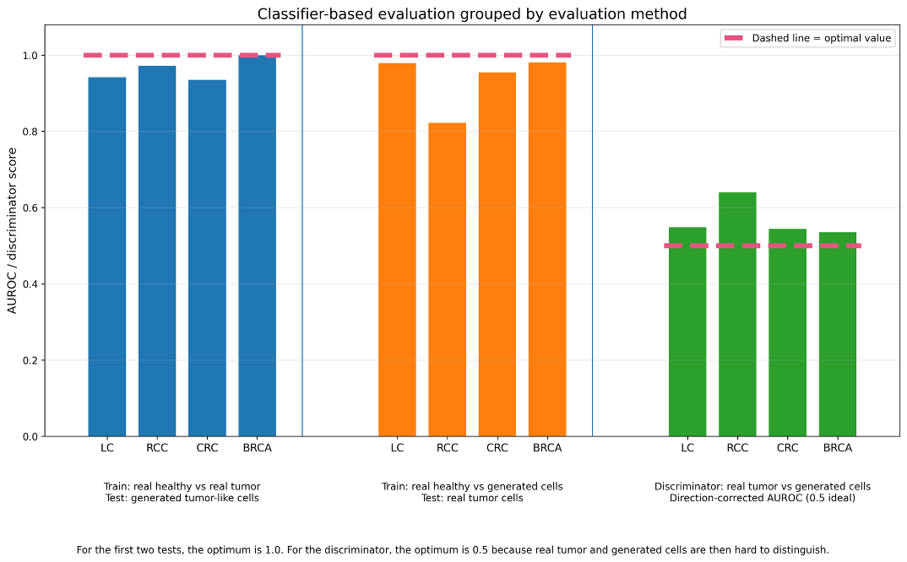
CancerZigZags performance of sampling tumor-state samples from healthy seeds was assessed via three tests:
(1) A classifier trained to discriminate between real healthy and real tumor cells and tested on generated tumor cells; (2) A classifier trained to discriminate real healthy cells and generated tumor cells and tested on real tumor cells; (3) A discriminator was implemented to discriminate generated and real tumor cells. Achieving great performance on these tests, a trade-off between tumor-likeness and seed specificity can be observed.
The framework explores tumour-associated molecular states starting from healthy-like cells within a learned generative landscape without knowledge of the start distribution. This clearly highlights this work compared to well known methods for distribution transformation such as optimal transport. Yet, the resulting paths should therefore be interpreted as computational exploration rather than biological time or lineage.
Future extensions could integrate perturbation experiments, regulatory information, treatment-response data, or additional biological constraints. Such information may eventually enable more mechanistic models of cancer-associated state changes.
Conclusion
CancerZigZag introduces an iterative diffusion-based approach for exploring tumour-associated single-cell states from unpaired data. By combining tumour-trained diffusion with healthy-like starting states, the framework enables nonlinear generative exploration of cancer-associated molecular landscapes.
Rather than reconstructing actual cancer progression, CancerZigZag provides a hypothesis-generating approach for studying possible relationships between healthy-like and tumour-associated cellular states by finding a transformation from one distribution into another with a single seed from the start distribution only.
Keywords
single-cell RNA sequencing, diffusion models, generative modelling, cancer, cell-state transitions, latent space, machine learning, trajectory analysis, tumour heterogeneity, genome data science, distribution transformation, optimal transport