Johannes Schlüter from Bielefeld University (UNIBI) will present two accepted papers at iscbAI’26. Together with Alexander Schönhuth, he investigates how computational methods and artificial intelligence can help extract new insights from complex molecular cancer data.
Linking gene expression and protein abundance
The first paper, “Retracing the Process of Translation: Proteome-wide mapping of stable transcriptomic predictors of protein abundance in cancer cell lines,” examines how gene expression relates to protein abundance.
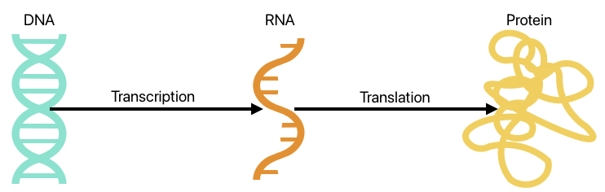
Using data from 940 cancer cell lines and 8,423 gene–protein pairs, the study applies interpretable machine-learning methods to identify stable transcriptomic predictors of individual proteins. The results reveal both recurring and protein-specific gene–protein associations and provide a framework for studying transcriptome–proteome relationships in cancer following the Central Dogma of Molecular Biology.
Generative AI for single-cell cancer data
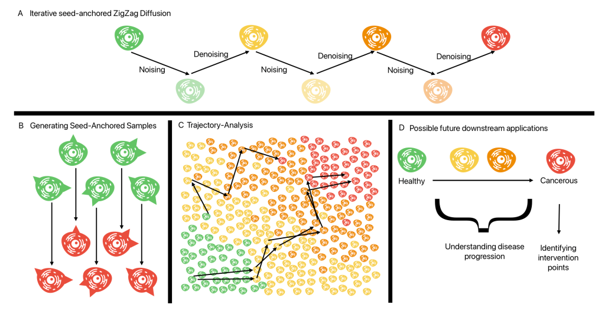
The second paper, “CancerZigZag: Iterative Seed-Anchored Diffusion for Generative Modeling of Single-Cell State Transitions,” introduces a generative AI approach for exploring tumor-associated single-cell states.
CancerZigZag uses diffusion models trained on tumor-derived epithelial cells to generate candidate tumor-associated states starting from healthy-like single cells. The framework was evaluated in colorectal, breast, lung and renal cell carcinoma and allows the exploration of possible molecular states even when paired or longitudinal observations are unavailable.