About Cell-Cell-Communication Networks, Embeddings and Transformers
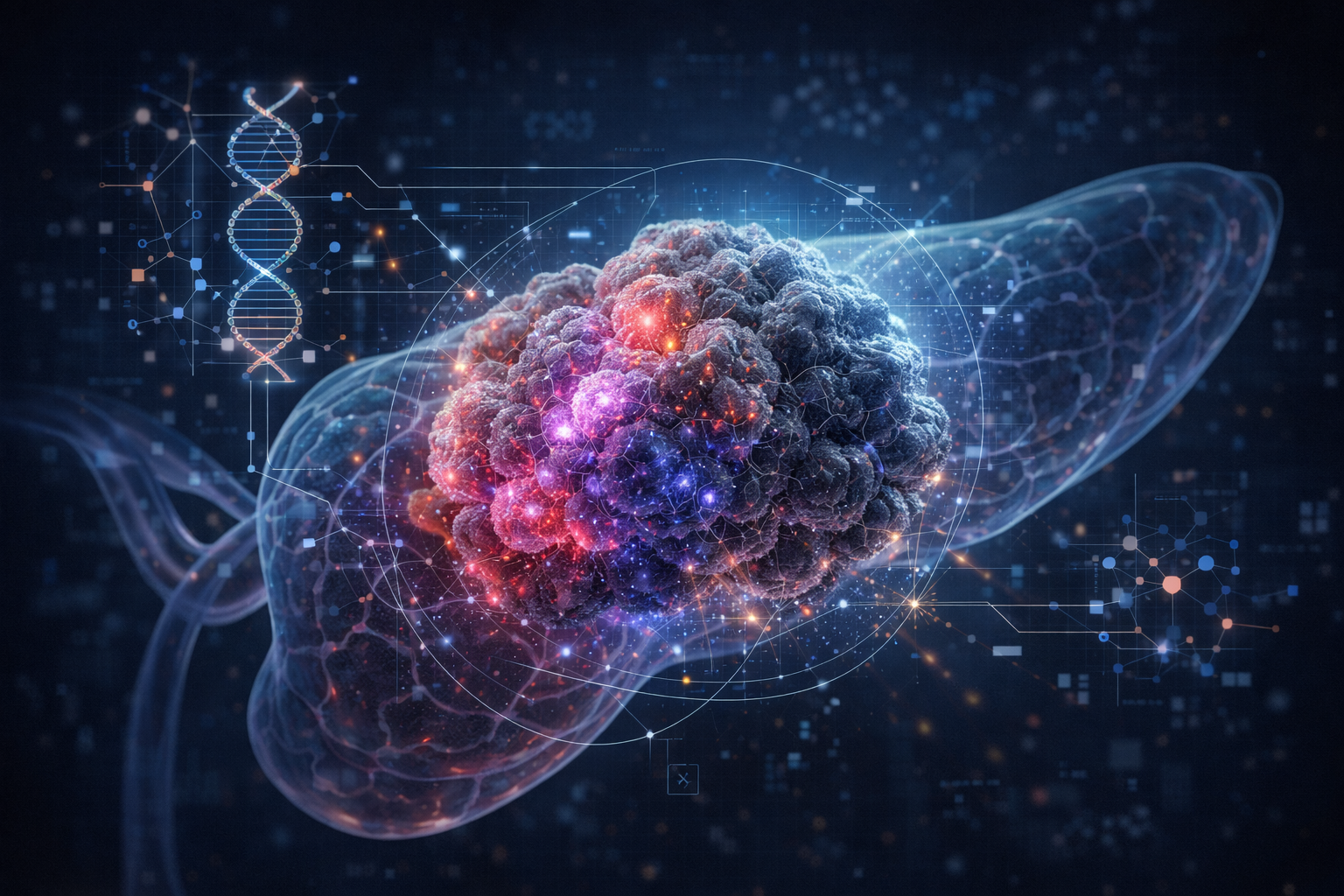
Tumour cells communicate through complex signalling patterns that evolve over time. Modern machine learning models using embeddings and attention mechanisms offer new ways to decode these interactions and reveal hidden structure in cancer communication networks.
Cell–cell communication is a fundamental mechanism underlying tissue organization and function. In cancer, these communication processes are profoundly altered, enabling tumour growth, immune evasion, and resistance to therapy. Understanding such interactions requires computational methods capable of modelling complex, high-dimensional signalling data and their context-dependent behaviour.
Recent advances in machine learning provide powerful tools for addressing this challenge. In particular, embedding-based representations and attention mechanisms offer a principled framework for learning structured, interpretable models of cell–cell communication networks in tumours.
Cell–cell communication networks in cancer
Cell–cell communication networks describe how cells exchange information through signalling molecules such as ligands and receptors. Each interaction depends on multiple factors, including expression levels, cell type, spatial organization, and temporal context. In tumours, these networks are highly dynamic, reflecting ongoing adaptation of cancer cells and their microenvironment.
The resulting data are complex and difficult to analyse with traditional approaches. Communication patterns are distributed across many interacting components, and biologically relevant signals often emerge only when considered in context. Machine learning enables the systematic modelling of these networks by learning compact representations of their underlying structure.
Embedding representations of cellular communication
Embeddings are low-dimensional, continuous vector representations that encode complex entities in a form suitable for machine learning. In the context of cell–cell communication, embeddings can represent cells, cell types, signalling molecules, or interaction events.
By learning embeddings from data, models can capture similarities and functional relationships between communication patterns. For example, cells with similar signalling behaviour can be mapped to nearby regions in embedding space, even if they differ at the level of individual molecular features. This representation learning step is crucial for reducing dimensionality while preserving biologically meaningful structure.
Embedding-based approaches also facilitate integration of heterogeneous data sources, enabling joint modelling of molecular profiles, signalling activity, and contextual information.
Attention mechanisms for context-dependent signalling
While embeddings provide a compact representation, they do not by themselves capture which signals are most relevant in a given biological context. The attention mechanisms address this limitation by allowing models to dynamically weight different components of the input.
In technical terms, attention computes context-dependent importance scores that determine how strongly individual signals contribute to a learned representation or prediction. This is particularly important for cell–cell communication, where the relevance of a signalling interaction depends on the cellular state, the surrounding microenvironment, and temporal dynamics.
Attention enables models to focus on critical communication events while suppressing noise and redundancy, thereby improving both performance and interpretability.
Integrating embeddings and attention in tumour communication models
The combination of embeddings and attention mechanisms can form the basis of modern approaches for analysing cell–cell communication networks. Embeddings encode cells and interactions into a shared latent space, while attention mechanisms selectively aggregate information based on biological context.
This integration allows models to capture complex dependencies between multiple signalling pathways, to adapt to different tumour microenvironments and to identify key drivers of communication changes during disease progression or treatment.
Such models provide insights not only into whether communication patterns differ, but also how and why these differences arise.
Transformer-based architectures for communication analysis
Transformer architectures extend attention-based modelling by stacking multiple attention layers, enabling hierarchical representation learning. This allows the model to capture both local and global communication patterns across cells and signalling events.
Applied to tumour communication networks, Transformers support the analysis of large-scale datasets and the modelling of long-range dependencies. Their modular design also facilitates interpretability, as attention weights can be inspected to highlight influential communication signals.
Toward digital twins of tumour communication networks
Embedding- and attention-based models represent an important step toward constructing digital twins of tumour communication networks. These computational models aim to simulate how cells interact under different conditions, including therapeutic interventions.
By learning data-driven representations of communication behaviour, such models enable hypothesis generation, in silico experimentation, and systematic exploration of tumour dynamics. While challenges remain, particularly regarding validation and data completeness, these approaches offer a promising pathway toward predictive modelling of cancer systems.
Conclusion
Embeddings and attention mechanisms provide a powerful and flexible framework for modelling cell–cell communication networks in cancer. By combining compact representations with context-aware weighting, machine learning models can capture the complexity and dynamics of tumour communication in a biologically meaningful and computationally reasonable way.
These methods contribute to a deeper understanding of tumour systems and support the development of advanced computational tools for CancerScan.
Keywords
cell-cell-communication, attention, transformer, machine learning, embeddings, data analysis, genome data science, cancer research, digital twin