CancerScan Digital Twin System receives EMA Breakthrough Device designation
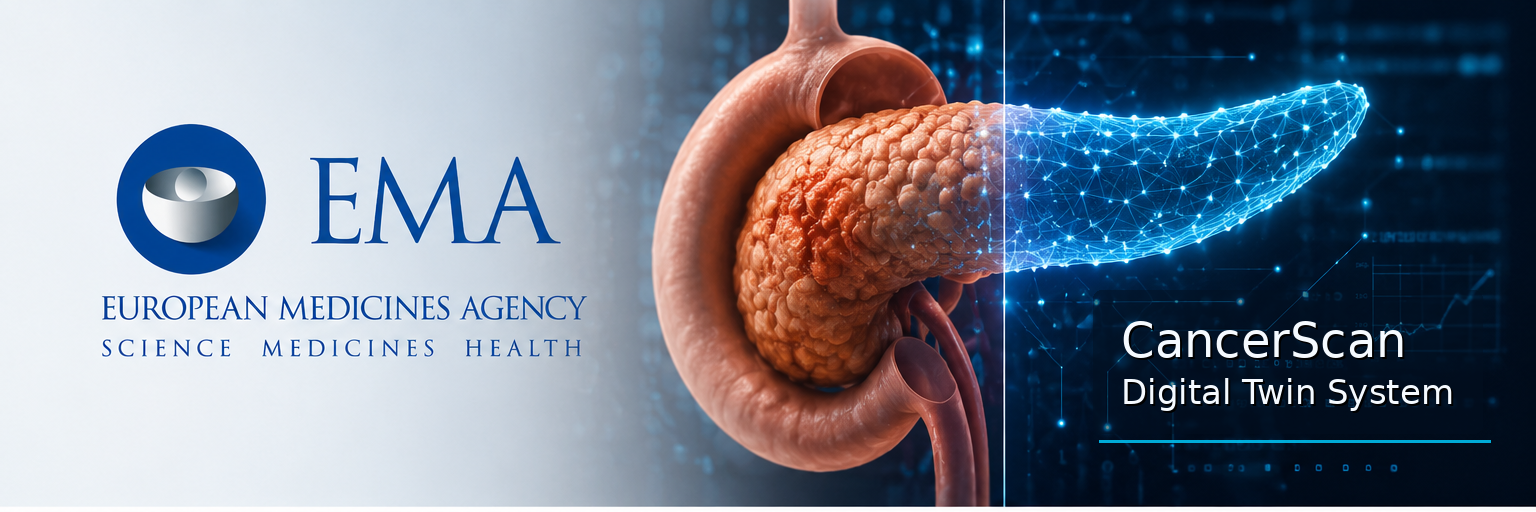
The CancerScan Digital Twin System, a medical device being developed within the CancerScan Project, has received EMA Breakthrough Device designation through the EMA Breakthrough Medical Devices Pilot.
A major regulatory milestone for CancerScan
The EMA Breakthrough Medical Devices Pilot is a landmark regulatory initiative for transformative medical devices. It is designed to provide the manufacturers of these first-in-class medical devices with early access to Europe’s leading clinical, scientific, and regulatory expertise, months or years before market entry.
The designation recognises the potential of the CancerScan Digital Twin System to address one of the most significant unmet medical needs in contemporary oncology: the absence of a validated, individualised treatment selection tool for patients with pancreatic ductal adenocarcinoma.
Following its successful Phase IA selection, the CancerScan Digital Twin System will progress to Phase IB, where structured engagement with the EMA Expert Panel is expected to begin in September 2026.
What Phase IB will provide
Phase IB will provide the CancerScan Digital Twin System with structured access to EMA Expert Panel guidance at a critical stage of its development.
This engagement will help clarify the clinical validation pathway, including study design, patient numbers, endpoints, comparator framework, performance thresholds, and the evidentiary requirements for CE marking as a Class III Software as a Medical Device. Seeing as the device has no established regulatory precedent, this guidance is foundational to the entire clinical development pathway.
The Expert Panel will also provide guidance on the pre-market clinical evaluation framework under the Medical Device Regulation, including how supporting evidence, such as organoid-derived pre-clinical data, may contribute to the clinical evaluation package. In parallel, CancerScan will receive input on the post-market clinical follow-up framework appropriate for an AI-based medical device, including model drift monitoring, real-world performance tracking, and out-of-distribution patient detection.
This early regulatory engagement will create a stronger foundation for future Notified Body dialogue and support preparation for the anticipated EIC Transition phase, where clinical validation and CE marking will be central objectives.
Securing the designation
Securing this designation required a carefully built case demonstrating that the CancerScan Digital Twin System meets the highest threshold of the breakthrough criteria: paradigm-shift innovation with significant positive clinical impact on patient health in a life-threatening condition.
The case was led by Neovivum CEO Igor Balaž, with the regulatory guidance and support from Irena Milobratović, founder and CEO of Indaea. As a certified Regulatory Affairs Professional, Irena played a key role in helping navigate the EU regulatory landscape and shape the submission to the EMA Expert Panel.
Together, Igor and Irena made the case across three dimensions:
First, they established that pancreatic ductal adenocarcinoma, with its dismal five-year survival rate of only 12%, clearly qualifies as a life-threatening and irreversibly debilitating condition, with a major unmet need in first-line treatment selection. No validated individualised treatment-selection tool currently exists for the broad population of patients being considered for first-line chemotherapy.
Then they demonstrated the technological novelty of the highest order as a first-in-class device, combining patient-specific mechanistic characterisation of the tumour microenvironment with digital twin simulation, with the aim of predicting how an individual patient’s tumour may respond to candidate chemotherapy regimens before treatment begins.
And lastly, they demonstrated the direct and measurable clinical impact of the device. In pancreatic cancer, first-line treatment failure can mean disease progression, cumulative toxicity, and rapidly narrowing second-line options. The ability to identify the most effective treatment regimen before chemotherapy is administered could therefore represent a meaningful improvement in clinical decision-making.

Looking ahead
Breakthrough designation by the EMA Expert Panel is a powerful signal of clinical and regulatory maturity. It is an important step in the development of the CancerScan Digital Twin System, confirming both the urgency of the clinical need it addresses and the potential of its first-in-class technological approach. By entering Phase IB, CancerScan will benefit from structured expert guidance at a critical stage of its regulatory and clinical development pathway, helping to shape the evidence framework required for future validation, CE marking, and clinical translation.
Links
Neovivum website: https://neovivum.com
Neovivum LinkedIn: https://www.linkedin.com/company/neovivum
Neovivum X: https://x.com/neo_vivum
CancerScan project website: https://www.cancerscanproject.eu/
LinkedIn channel: http://www.linkedin.com/company/cancerscan-project
X channel: https://x.com/CancerScan_eu
YouTube channel: https://www.youtube.com/@cancerscan-Project
Indaea website: https://indaea.co/
Keywords
CancerScan digital twin system, breakthrough device, first-in-class, EMA, pancreatic ductal adenocarcinoma, software as a medical device, precision oncology, individualised treatment selection, personalized cancer therapy