CancerScan 1st Review Meeting: Evaluating project achievements
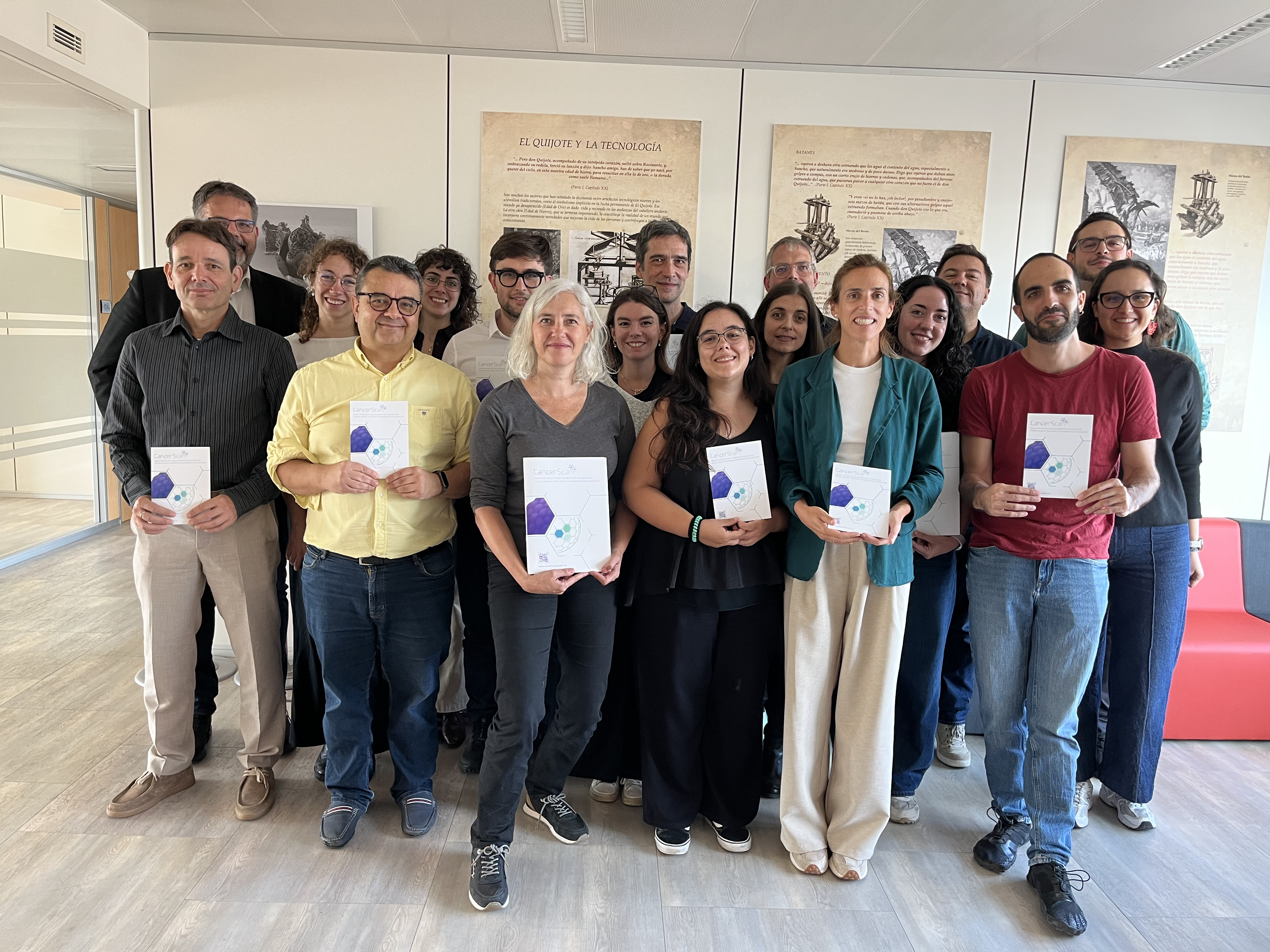
On October 2, 2026, the CancerScan consortium gathered at the CSIC Delegation in Brussels for its first Reporting Period (RP1) Technical and Scientific Review Meeting. The primary goal of this event was to evaluate the progress of the CancerScan Horizon Europe Pathfinder initiative. By uniting expertise across biology, artificial intelligence, and hardware engineering, CancerScan is developing a smart pathology slide scanner capable of generating patient-specific tumour digital twins. This breakthrough technology aims to transform personalised oncology by empowering clinicians to simulate and rank precise treatment options for pancreatic cancer.
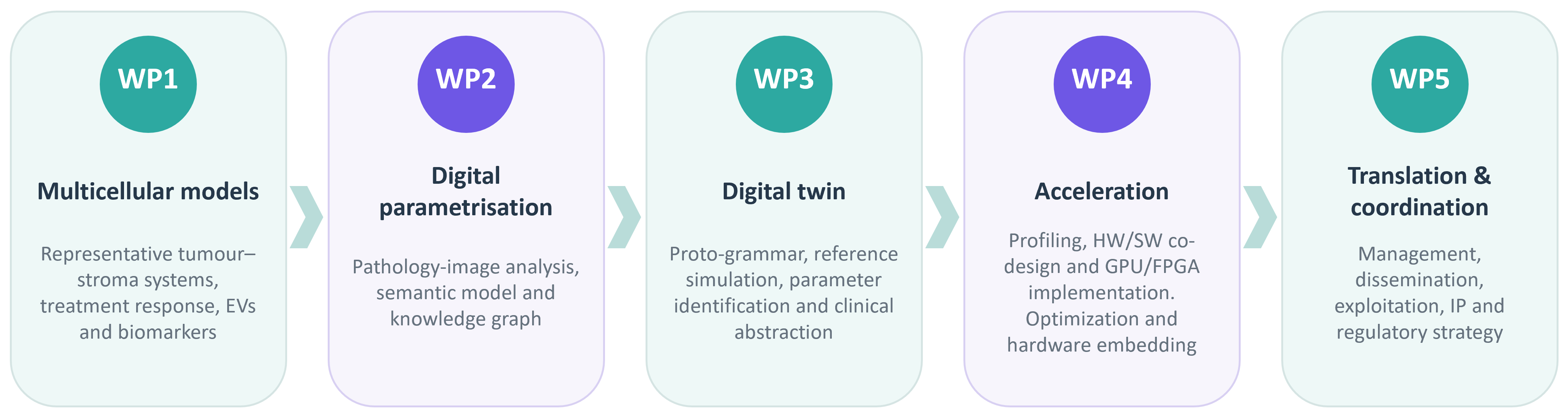
During the review, the consortium detailed the main achievements across its integrated five work packages (WP), highlighting the collaborative efforts of the partner organisations.
WP1: Multicellular Models
Led by the Vall d’Hebron Research Institute (VHIR), WP1 develops the living biological models that form the foundation of the project. In RP1, the team generated and screened approximately 40 multicellular spheroid configurations, prioritising four representative models for pancreatic ductal adenocarcinoma (PDAC). They also successfully established tracking protocols for extracellular vesicles (EVs) and demonstrated the feasibility of deep-coverage proteomics.
WP2: Digital Parametrisation
Coordinated by FCiências.ID (FC.ID) alongside Bielefeld University (UNIBI), WP2 translates experimental data into semantic models and knowledge graphs. Achievements include annotating roughly 800 regions from whole-slide images to train classification models capable of distinguishing normal parenchyma, chronic pancreatitis, and tumour tissue. The team also delivered the first semantic model, linking 55 concepts and 62 relationships across 36 biomedical ontologies.
WP3: Digital Twin & Proto-grammar
Led by Neovivum (NEO), WP3 translates biological networks into a predictive simulation framework. To balance scientific accuracy with the speed required for clinical use, the team adopted a dual-track architecture: a highly detailed spatial partial differential equation (PDE) reference model, and a faster ordinary differential equation (ODE) engine designed for real-world clinical deployment. The core tumour microenvironment model now features six coupled modules addressing transport, cell kinetics, and vascular support.
WP4: Hardware Acceleration
Politecnico di Milano (POLIMI) focuses on optimising and embedding the simulator. Profiling of the Track 1 PDE simulator revealed that diffusion-decay processes account for nearly 83.9% of execution time. To resolve these bottlenecks and ensure the system runs smoothly in clinical timeframes, POLIMI is actively exploring GPU and FPGA-oriented implementation strategies.
WP5: Translation & Coordination
Coordinated by the Spanish National Research Council (CSIC) with task contributions from MINDS & SPARKS (M&S) and NEO, WP5 ensures smooth project management, dissemination, and clinical translation. A major RP1 highlight was CancerScan’s acceptance into Phase IB of the European Breakthrough Medical Devices pilot. This early milestone secured independent validation of the device’s regulatory strategy and clinical novelty from the EMA Expert Panel.
The meeting concluded with a clear roadmap for the second reporting period, where the consortium will transition from laying individual foundations to deep data integration and model calibration.
Links
https://www.cancerscanproject.eu/
http://www.linkedin.com/company/cancerscan-project
https://www.youtube.com/@cancerscan-Project
Keywords
Tumour digital twins, Personalised oncology, Pancreatic cancer, Multicellular models, Digital parametrisation, Predictive simulation, Hardware acceleration, Digital pathology, Breakthrough Medical Devices